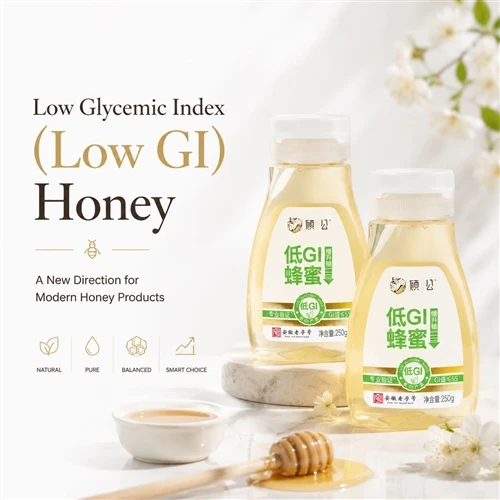
Low Glycemic Index (Low GI) Honey
A New Direction for Modern Honey Products

Low GI Honey
Honey has been appreciated around the world for thousands of years. From ancient traditions to modern kitchens, it remains one of the most recognized natural sweeteners, valued for its floral aroma, smooth texture, and close connection with bees and flowering plants.
However, the way consumers choose food products is changing.
Today, people are not only interested in taste and origin. They are also paying more attention to ingredient transparency, nutritional information, and how different foods fit into their daily lifestyles. This change has encouraged many food categories to develop more clearly defined product concepts, including breakfast foods, beverages, snacks, and natural sweeteners.
Within the honey industry, Low Glycemic Index (Low GI) Honey is one example of how traditional honey products are evolving to meet new market expectations.
Rather than replacing conventional honey, Low GI Honey represents another product direction-combining the familiar experience of natural honey with clearer nutritional positioning.
The term Glycemic Index (GI) is used to describe how carbohydrate-containing foods may influence blood glucose response after consumption under standardized testing conditions.
Foods with different carbohydrate structures can produce different glycemic responses. Generally, foods with a lower GI value are associated with a slower and more gradual release of glucose compared with many higher-GI carbohydrate foods.
According to commonly used GI classification, foods with a GI value of 55 or below are generally considered low GI.
Low Glycemic Index Honey refers to a honey product with a declared GI value within this range. It provides consumers with additional information about the product's characteristics and allows the honey category to communicate product positioning in a clearer way.
It is important to understand that Low GI Honey is still honey. It is not sugar-free, does not mean carbohydrate-free, and is not positioned as a medical product. Like other sweet foods, it should be enjoyed as part of an overall balanced dietary pattern.
The value of Low GI Honey lies in providing more transparent product information rather than making unrealistic promises.
Why Are Consumers Paying Attention to Low GI Foods?
The growing interest in Low GI products reflects a broader change in consumer behavior. In the past, food choices were often based mainly on taste, price, and convenience. Today, many consumers are also considering:
where ingredients come from
how products fit into their lifestyle
nutritional information on labels
portion awareness
balanced eating habits
product transparency and clear communication of food characteristics
This trend can be seen across many food categories. Consumers are increasingly looking for products that allow them to enjoy familiar foods while having a clearer understanding of their characteristics.
For honey, this creates an opportunity to develop more differentiated products. Instead of offering only traditional sweetness, honey brands can explore new product concepts that match different consumer preferences.
Low GI Honey is part of this wider movement toward more informed food selection.
Traditional honey is usually evaluated through characteristics such as floral source, color, aroma, taste, and texture.
For example, acacia honey is often recognized for its light color and mild floral character, while darker varieties may have stronger aromas and richer flavors. These differences come from the plants visited by bees and the natural environment where the honey is produced.
Low GI Honey introduces another consideration: glycemic positioning.
Its main difference is not necessarily a completely different eating experience. Instead, it provides a product concept with additional information that helps consumers understand the honey from another perspective.
For retailers and brands, this creates an opportunity to develop honey collections with clearer market segmentation:

traditional floral honey for consumers who value origin and flavor
premium honey varieties for customers seeking unique sensory experiences
Low GI Honey for consumers interested in nutritional concepts and modern lifestyle choices
The Natural Factors Behind Honey Characteristics
Honey is a natural product with a complex composition.
The final characteristics of honey are influenced by many factors, including floral source, climate conditions, harvesting time, moisture content, and natural sugar composition.
Honey naturally contains different types of sugars, mainly fructose and glucose. The balance of these components can influence sweetness perception, crystallization behavior, texture, and other physical characteristics.
This natural complexity is one reason why honey cannot be treated as a completely standardized product like many refined sweeteners.
For Low GI Honey, clear product positioning requires reliable testing and accurate communication. A declared GI value should be supported by appropriate evaluation methods and product specifications, allowing customers and buyers to better understand the product.

Low GI Honey in Everyday Food Applications
One advantage of Low GI Honey is that it maintains the familiar usage experience of honey.
Consumers can continue enjoying honey in common food occasions, including:
- spreading on bread or pancakes;
- adding to yogurt or oatmeal;
- mixing into tea, coffee, or milk-based beverages;
- pairing with fruits and breakfast foods;
- using as an ingredient in bakery and food preparation.
Its role is not to completely change how people use honey, but to provide another option for consumers who prefer products with clearer nutritional information.
For food brands, retailers, and private-label companies, this flexibility creates opportunities to develop products for different market segments.
Why Low GI Honey Matters for the Honey Industry
The development of Low GI Honey reflects an important trend in the modern food industry: traditional products are increasingly being combined with clearer product concepts.
Honey has always been connected with nature. It begins with flowers, continues through the work of bees, and reaches consumers through careful harvesting and processing.
At the same time, food markets continue to change. Consumers want products that are natural, understandable, and aligned with their personal preferences.
Low GI Honey represents one way the honey industry responds to this evolution.
It does not replace traditional honey. Instead, it expands the possibilities of how honey can be positioned, communicated, and enjoyed.
Opportunities for Honey Importers and Brands
For importers, retailers, and private-label brands, understanding consumer trends is essential when developing product portfolios.
A successful retail honey range often includes products with different characteristics, applications, and market positions.
Low GI Honey can serve as an additional option for companies looking to introduce differentiated honey products, especially in markets where consumers are paying more attention to nutritional information and lifestyle-oriented food choices.
With suitable packaging, clear labeling, and reliable documentation, Low GI Honey can be developed for various retail applications, including household products, breakfast ranges, wellness-oriented collections, and private-label projects.
Conclusion
Honey has always been more than a sweetener. It represents a connection between plants, bees, nature, and human food culture.
The emergence of Low Glycemic Index Honey shows how traditional natural products can continue to develop alongside changing consumer expectations.
By combining the familiar qualities of honey with clearer product information, Low GI Honey provides another perspective on how honey can meet the needs of modern markets.
For consumers, it offers another informed choice.
For brands and retailers, it represents another opportunity to build diverse and meaningful honey product lines.

Our Low GI Honey Product
Based on this product concept, we have developed our 250g Low Glycemic Index (Low GI) Honey for retail markets.
The product combines the familiar taste and aroma of natural honey with a clearly communicated GI value (GI ≤55), providing retailers and brands with another option for consumers who are looking for more informed sweetness choices.
With a convenient 250g squeeze bottle format, it is suitable for everyday applications such as breakfast, beverages, and food pairing, while also supporting OEM and private-label development according to market requirements.