Why Do Bees Collect Tree Resin? The Fascinating Story Behind Propolis
Bees collect tree resin to make propolis, a sticky, resinous material commonly known as bee glue. Western honey bees (Apis mellifera) gather resin from tree buds, bark, and other plant surfaces, carry it back to the hive, and mix it with beeswax and their own secretions. The resulting material helps seal, reinforce, and protect the colony.
When we think about honeybees, the first things that come to mind are usually flowers, nectar, and honey. But there is another material that bees actively collect from the natural world: tree resin.
You may have noticed a sticky substance on tree buds, bark, or damaged branches. For honeybees, this material is more than just plant resin. They collect it, carry it back to their hives, and turn it into something essential to their home.
So, why do bees collect tree resin? And what do they actually do with it?
Let's take a closer look at the fascinating story behind propolis.

Why Do Trees Produce Resin?
Before understanding why bees collect resin, it helps to know why trees produce it in the first place.
When a tree is damaged, its natural defense mechanisms may include releasing resin around the affected area. You can sometimes see it as a sticky substance on tree bark, broken branches, or buds.
Tree resins are complex plant materials containing various naturally occurring compounds. Depending on the plant species, they can help protect vulnerable plant tissues against certain insects and microorganisms.
For bees, these sticky plant materials are valuable resources.
Worker bees search for suitable resin sources on trees and other plants, particularly around buds and damaged areas. They collect the material and bring it back to the hive.
Interestingly, bees are not collecting resin to make honey. They have a completely different purpose for it.
How Do Bees Collect Tree Resin?
Collecting tree resin is quite different from collecting nectar or pollen.
When a worker bee finds a suitable resin source, it uses its mandibles to scrape and gather the sticky material.
The resin is then transferred using its legs and packed onto the pollen-carrying structures of its hind legs, known as pollen baskets or corbiculae.
Unlike pollen, however, resin is extremely sticky. It can be difficult for bees to handle, and collecting it requires considerable effort.
Once enough resin has been gathered, the bee returns to the hive.
Other worker bees help remove the resin from the returning forager. The material is then processed and used in different parts of the hive.
This is one reason why resin collection is a specialized activity within a honeybee colony. Not every worker bee spends its time collecting the same materials.
How Bees Turn Tree Resin Into Propolis
Here is where the story becomes particularly interesting.
The tree resin collected by bees is not exactly the same as the finished propolis we know.
After returning to the hive, worker bees process the collected resin. They combine it with beeswax and their own secretions to form propolis.
The exact composition varies depending on the plant materials collected and the characteristics of the colony.
The resulting material is sticky, resinous, and suitable for several purposes inside the hive.
The name propolis comes from Greek roots: pro and polis, commonly interpreted as referring to something positioned in front of or protecting a city. It is a fitting name for a material that helps protect a honeybee colony.
Propolis is also commonly called bee glue because of its sticky nature and its role in sealing gaps.
It is one of the most interesting examples of how honeybees make use of materials collected from their surrounding environment.
What Is Propolis Used for in a Hive?
A honeybee hive is a busy environment. Thousands of bees live together in a relatively enclosed space, with brood, stored food, and honeycomb all sharing the same structure.
Maintaining this environment requires more than building honeycomb.
Propolis plays several important roles.
Sealing Small Gaps
Bees use propolis to fill cracks and small openings in the hive. This helps reduce unwanted spaces and makes the structure more enclosed.
Coating Internal Surfaces
Worker bees can spread thin layers of propolis over parts of the hive interior. This contributes to the colony's natural defense system.
Reinforcing the Hive
Propolis can also be used to secure loose parts and reinforce certain areas of the hive structure.
Supporting Colony Hygiene
Plant resins contain naturally occurring compounds with antimicrobial properties. Research suggests that propolis can contribute to the honeybee colony's social immune defenses, helping reduce certain microbial challenges within the hive.
In other words, bees do not collect tree resin simply because it is available. They collect it because it serves a practical purpose in maintaining their home.
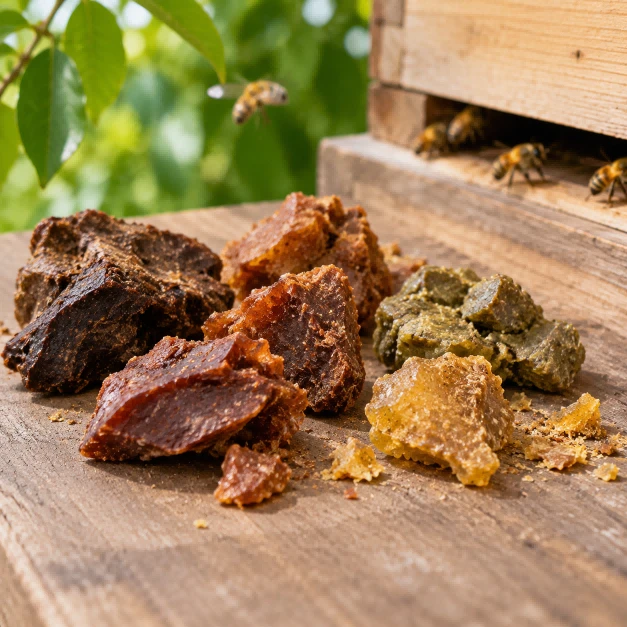
Why Does Propolis Have Different Colors and Smells?
If you have ever seen different samples of raw propolis, you may have noticed that they do not all look alike.
Some are dark brown, while others may appear reddish, yellowish, or greenish. Their aromas and textures can also vary.
Why?
The main reason is the source of the plant resins.
Honeybees collect resin from different plants depending on their geographical location and the vegetation available around their colonies.
For example, poplar, birch, willow, and other resin-producing plants can contribute to the materials used in propolis production.
Different plants have different chemical compositions. As a result, the characteristics of the resulting propolis can vary considerably.
The season of collection and local environmental conditions can also influence its composition.
This explains why propolis from different regions may have different appearances, aromas, and chemical profiles.
For buyers and manufacturers, botanical origin and product specifications are important considerations when evaluating propolis materials.
From Hive to Industry: Understanding Propolis
Humans have been familiar with propolis for a very long time.
Historical records show that people in different civilizations used bee-collected resinous materials for various purposes.
Today, propolis is collected and processed into different commercial forms, including raw propolis, propolis extracts, powders, and encapsulated products.
Its naturally occurring flavonoids and phenolic compounds are among the characteristics that attract interest from researchers and product developers.
At Hefei Zhicheng Apiculture Co., Ltd. (Gugong), propolis is one of the bee products in our product portfolio. We also offer other bee-derived products, including royal jelly and bee pollen.
For businesses interested in bee-product sourcing, understanding the origin, composition, and processing of these materials is an important starting point.
When evaluating raw propolis, buyers may consider several factors:
Botanical origin: The plants from which the bees collect resin.
Geographical origin: The region where the propolis is collected.
Product characteristics: Appearance, aroma, texture, and composition.
Product specifications: Relevant quality indicators and agreed testing requirements.
Processing requirements: Whether the material is intended for further processing or a particular finished product.
1. Do All Honey Bees Make Propolis?
Not all bee species collect and use resin in the same way. Propolis collection is particularly well documented in Western honey bees (Apis mellifera). Some other bee groups, such as stingless bees, also collect plant resins for use in their nests.
2. Is Propolis the Same as Beeswax or Honey?
No. Honey is made from nectar or other plant-derived sugary secretions, while beeswax is secreted by worker bees. Propolis is made primarily from collected plant resins combined with beeswax and bee-derived secretions. Each has a different origin and purpose in the hive.
3. Why Is Propolis Called Bee Glue?
Propolis is commonly called bee glue because of its sticky consistency and its use in sealing gaps, fixing materials, and reinforcing parts of the hive.
4. What Should Buyers Check When Sourcing Raw Propolis?
Buyers should consider the botanical and geographical origin, product characteristics, composition, relevant quality specifications, and available testing documentation. These details help determine whether a particular batch is suitable for the intended application.
These factors help buyers better understand the material and identify suitable sourcing options.
If you are looking for raw propolis or other bee products for your business, you are welcome to explore our product range and contact our team to discuss your requirements.
Conclusion: A Small Material with an Important Role
The next time you see a sticky drop of resin on a tree, remember that it may be exactly the kind of material a honeybee is looking for.
What begins as part of a tree's natural defense system can become an important resource inside a honeybee colony.
Bees collect it, carry it home, and transform it into propolis, helping to seal, maintain, and protect their hive.
It is a fascinating example of how honeybees make use of the natural resources around them, turning a simple plant material into something valuable for their entire colony.
Nature often provides the materials. Bees show us what can be done with them.